Hairdresser jobs in Australia for Malaysians: a year of salon work and a portfolio come first
Tips · 2026-10-23 · 10 min read
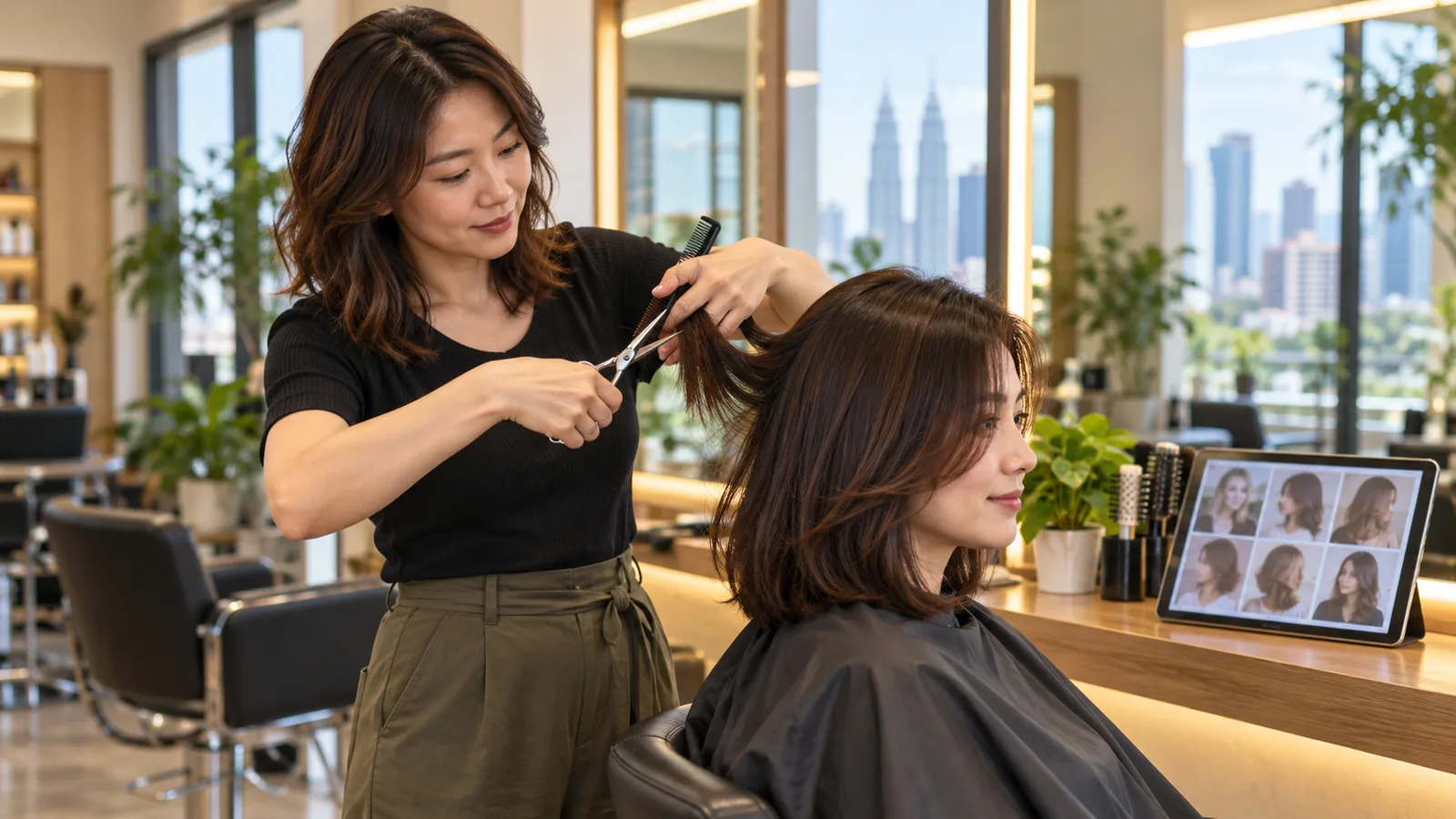
Hairdresser jobs in Australia for Malaysians usually come through an employer who sponsors you, and the sponsor and the visa rules look at three things first: proof that you can cut and colour to a salon standard, at least a year of recent paid work in the trade, and the right paperwork for your occupation. An SKM certificate helps you show your training, but on its own it does not get you hired. Below is what to prepare, in the order Malaysian hairdressers and barbers tend to need it.
What a sponsoring salon is actually checking
Australia's Skills in Demand (subclass 482) visa exists so an employer can sponsor a suitably skilled worker for a position it cannot fill with a suitably skilled Australian. The real question is whether you can do the job on day one.
For a salon or barbershop, that means your work: the cuts, fades, colour corrections and styling you do every week. Plan to show three things:
- A portfolio of your own work. Clear before-and-after photos and short clips, labelled with the service (for example "balayage on dark Asian hair" or "skin fade with a beard line-up"), taken on clients who agreed to it.
- A clean work history. Employment letters that list your duties, your hours and your dates, not just your job title.
- Your training. Your SKM or DKM certificate, plus any short courses in colour, chemical work or barbering.
As our managers' guide puts it, assessors read your duties, not your name card: a letter that only says "Senior Stylist" proves little.
Where your SKM fits in
The Malaysian Skills Certification run by the Department of Skills Development (Jabatan Pembangunan Kemahiran, JPK) has five levels: SKM Tahap 1, SKM Tahap 2, SKM Tahap 3, Diploma Kemahiran Malaysia (DKM) Tahap 4 and Diploma Lanjutan Kemahiran Malaysia (DLKM) Tahap 5. JPK says the certification is recognised by industry in Malaysia and offers a career path comparable to an academic one.
JPK also lists three ways to earn it: training at an accredited centre (SLaPB), the National Dual Training System (SLDN) that mixes salon work with a skills institution, and recognition of prior achievement (PPT), where an assessor reviews evidence from your past work or training. If you learned hairdressing on the job in a salon in Johor Bahru or Penang and never sat a course, PPT is the route worth asking about at home before you apply abroad. Details are on JPK's SKM page.
Australia and New Zealand do not automatically accept an SKM as their own qualification. Treat it as strong evidence, not a licence. If you want the wider picture for tradespeople, read our guide for SKM holders on Australia's skills shortage.
The visa rules that shape a hairdresser's offer
Most sponsored salon jobs run through the 482 visa. In its Core Skills stream, the occupation must be on the Core Skills Occupation List (CSOL), and the worker must be paid the Annual Market Salary Rate for the role and no less than the Core Skills Income Threshold (CSIT). For nominations lodged from 1 July 2026 to 30 June 2027, the CSIT is AUD79,423.
That is roughly RM225,000 a year, using the Reserve Bank of Australia's rate of 2.8372 ringgit per Australian dollar published for 16 Oct 2026. It is a rough comparison only: rates change, and Australian living costs are much higher.
The other rules that matter for a stylist or barber:
| Requirement | What it means for you |
|---|---|
| Work experience | At least 1 year of relevant work in the occupation or a related field, gained within the last 5 years; part-time or casual work must add up to 12 months full-time. |
| Occupation list | The combined list of eligible skilled occupations shows which list the occupation is on and names its skills assessing authority. |
| Skills assessment | Some 482 applicants need a mandatory assessment by Trades Recognition Australia or VETASSESS, started before the visa is lodged. |
| English | An IELTS score of at least 5.0 in each part, or the equivalent on another accepted test, unless an exemption applies. |
| Who you work for | Only the sponsoring business, and only in the occupation you were nominated for. |
Look up "Hairdresser" and "Barber" yourself on the combined list of eligible skilled occupations before you sign anything. It tells you which list each occupation sits on and who assesses it, and lists can change.
For the full rules, fees and family options, see our Skills in Demand (482) visa guide for Malaysians.
If a skills assessment applies to you
A skills assessing authority checks that your skills meet the standard it sets for an occupation, and Home Affairs only accepts an assessment from the authority named for that occupation. Each authority sets its own steps, timeframes and charges.
If your occupation needs a mandatory assessment for the 482, it must be started before the visa application is lodged, and within the 3 years before you apply. Otherwise the application is not valid. An assessment with no validity period shown lasts 3 years from the date it is issued.
Where Trades Recognition Australia is the authority, its Migration Skills Assessment is documentary: it compares your qualifications and employment history with Australian standards. TRA does not award Australian qualifications, registrations or licences, so a positive result is not a certificate to work anywhere you like.
Longer term, the Skilled Employer Sponsored Regional (subclass 494) visa asks for at least 3 years of relevant experience and a skills assessment. Designated regional areas cover all of Australia except Sydney, Melbourne and Brisbane.
Step by step: from your salon in Malaysia to an Australian chair
- Check the occupation. Find Hairdresser or Barber on the combined list and note the list and the assessing authority.
- Count your experience. Add up your paid salon work in the last 5 years and make sure it reaches at least 12 months full-time.
- Collect proof. Ask past employers for signed letters with duties, hours and dates. Gather payslips and your SKM or DKM. If any of it is in Bahasa Malaysia, read our guide to translating Bahasa Malaysia documents for a visa.
- Build your portfolio. Pick your strongest recent looks and keep them in one shareable folder. Then turn your salon history into an English CV: Build AI CV helps you lay out services, dates and duties clearly.
- Sit an accepted English test. Book a test at a test centre (Home Affairs does not accept at-home tests such as IELTS Online). PractiseNow has IELTS and PTE practice if you want to warm up first.
- Apply to sponsored roles. Browse hair and beauty jobs in Australia and New Zealand, such as the live barber job in Perth and barber job in Burnie, Tasmania. Send an English CV, your trade certificates and your references.
- Prepare for a trade test. Interviews are usually by video call and sometimes include a practical or trade test, so be ready to cut on a model or show live work.
- Order your police certificate once an offer is close. Apply for the Certificate of Good Conduct (Sijil Kelakuan Baik) on e-Konsular: the service charge is RM20.00, processing is within 30 working days after a complete application, and it is valid for 1 year from approval. Upload your job offer letter as the supporting document.
Optional: a verified Talent Tabloid profile lets employers check your experience and can help your application stand out.
New Zealand: a second door for stylists
New Zealand's Accredited Employer Work Visa (AEWV) is for people with a job offer from an accredited employer, who sends you the link to the online application. You need 2 years or more of relevant job experience, or a qualification at level 4 or higher on the New Zealand Qualifications and Credentials Framework, in the same field as the job. The full details are on Immigration New Zealand's AEWV page.
Do not assume your DKM equals a New Zealand level 4. NZQA's International Qualification Assessment compares an overseas qualification with New Zealand qualifications, and NZQA says average waits are now 10 weeks, so start early if you want that comparison. Our AEWV guide for Malaysians covers the rest.
Common mistakes Malaysian hairdressers make
- Relying on the certificate alone. The 482 asks for at least a year of relevant work, and salons hire on what they see in your portfolio and trade test.
- Vague employment letters. "Worked as stylist" with no dates or duties gives an assessor or case officer nothing to compare.
- Paying for a sponsorship. It is illegal to pay an employer to sponsor you, including through salary deductions, and it can lead to visa refusal or cancellation, fines or prison. The employer must pay its own sponsorship costs and cannot pass them to you.
- Flying in on a visitor visa to "start first". You cannot work in Australia on an ETA or Visitor visa. The Australian High Commission warns that facilitators in Malaysia arranging visas and flights for paid work are running a scam, and working in breach can lead to detention, removal and a three-year exclusion.
- Interviewing only on WhatsApp. Wisma Putra tells Malaysians to reject offers with interviews only through messaging apps, or with no verifiable address or website. If it goes wrong, read what to do if you kena scam kerja luar negara.
Australian employers are also widening the net. The Employer-Sponsored planning level for 2026-27 is 58,040 places, up from 44,000 in 2025-26. For the employer side of that picture, Employer Sponsored Jobs explains why Australian employers are turning to sponsorship. A bigger program is not a promise of a place for any one applicant.
Frequently asked questions
Can I get a hairdresser job in Australia with only an SKM certificate?
Not on the certificate alone. A 482 applicant needs at least 1 year of relevant work experience in the last 5 years, and salons usually judge you on your portfolio and a practical test. The SKM is strong evidence of training that supports the rest.
Do barbers and hairdressers need a skills assessment for Australia?
It depends on the occupation and the visa. The combined list of eligible skilled occupations names the assessing authority for each one, and some 482 applicants must have a mandatory assessment started before they lodge. Check your exact occupation on the Home Affairs list.
What English score does a hairdresser need for the 482 visa?
For tests taken on or after 13 September 2025, the 482 Core Skills stream asks for at least 5.0 in each IELTS component, or the equivalent on another accepted test. Applicants who completed at least 5 years of full-time study mostly taught in English can be exempt.
Who pays the sponsorship costs for a salon job?
The employer. Home Affairs says the sponsor must pay all costs of becoming a sponsor and nominating you and cannot pass them to you or your family. Paying an employer for sponsorship is illegal and can end your application.
Is New Zealand easier for Malaysian hairdressers than Australia?
Not easier, just different. The AEWV needs an offer from an accredited employer and 2 years or more of relevant experience, or a qualification at New Zealand level 4 or higher in the same field.
Key takeaways
- Salons sponsor on proof of skill: a portfolio, detailed employment letters and often a practical test.
- The 482 needs at least 1 year of recent relevant experience and a salary no lower than the CSIT of AUD79,423.
- Check Hairdresser and Barber on the combined occupation list for the list and the assessing authority.
- Your SKM or DKM supports your application but is not an Australian or New Zealand qualification.
- Never pay for sponsorship and never travel to work on a visitor visa or ETA.
#hairdresser jobs australia #barber jobs australia sponsorship #skm hairdressing #hair and beauty jobs abroad #kerja salon australia #malaysian hairdressers
 Translating Bahasa Malaysia documents for a visa? The four details Australia wants on every page
 Farm jobs in Australia for Malaysians: 1,100 visa places, and a fruit-picking trap to avoid
 Kena scam kerja luar negara? What Malaysians can do in the first 24 hours after paying