Offshore workers in meat and pork jobs: why Western Australia's visa queue matters to you
News · 2026-09-07 · 3 min read
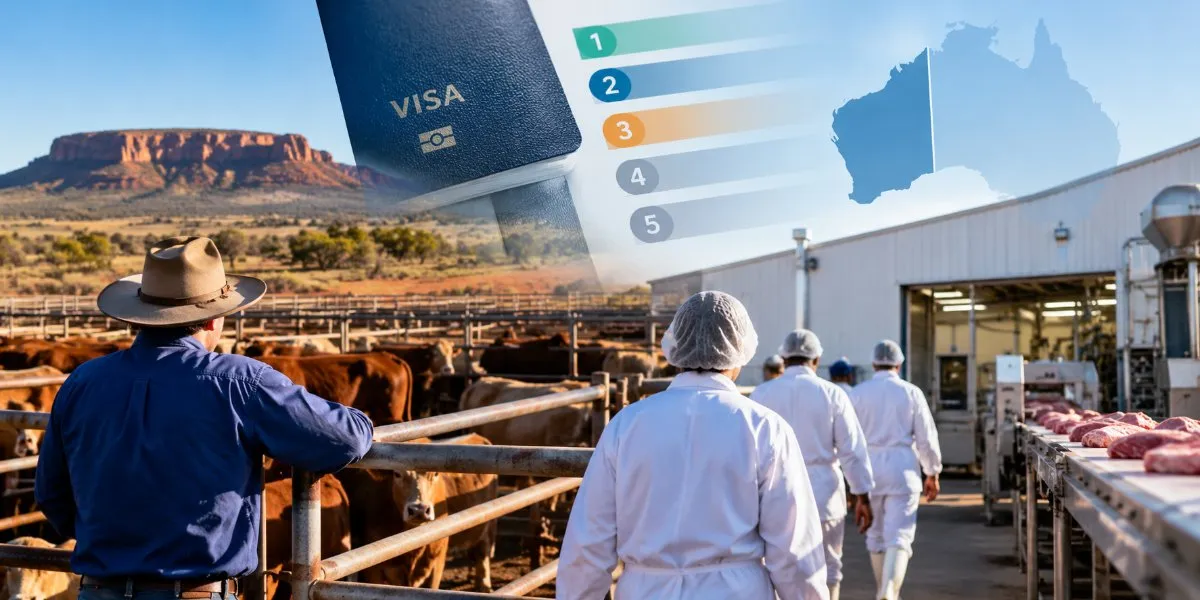
Applying for a job in Australia from outside the country is a waiting game at the best of times. A recent change to how Australian visa applications are ordered has made the wait harder to predict, and Western Australia's meat and pork industries show why. If you are a Malaysian worker thinking about meat processing or farm work, it helps to understand what is going on.
A queue with five tiers
In July, the Department of Home Affairs introduced a five-tier system for deciding which skilled visa applications are handled first. Offshore applicants in industries outside law enforcement, defence, construction, healthcare and teaching sit at the very bottom. Meat processing is not on the priority list, and neither is pork production.
On paper that is understandable, because the idea is to protect the local labour market. The trouble is that some industries have never had a local workforce large enough to protect.
Two Western Australian examples
In the Kimberley, an abattoir near Broome advertised 60 skilled positions and received exactly one application from an Australian resident, who did not hold the required skills. The business had lined up around 30 skilled workers from overseas, plus 13 partners, to restart operations. About $390,000 in visa fees has already been paid. The opening planned for this year has slipped to a soft launch in February and a full commercial opening in April, while thousands of cattle still need somewhere to go.
Further south, near Narrogin, a piggery draws about 90 per cent of its workforce from overseas. It is growing from 1,500 to 2,500 sows, with piglets due in six months, and it cannot be sure its incoming workers will have visas in time. Many were recruited back in January, and some have already left their previous jobs.
Why this is a lesson for applicants
These cases are not about employers choosing cheaper labour. Remote operations simply cannot find enough local people, whatever pay they offer. But they show three timelines that rarely match: the employer's hiring plan, the visa processing time, and the business calendar that does not stop for either. A piggery keeps breeding while it waits, and cattle cannot wait forever for an abattoir to open.
The Department says applications continue to be processed in line with program requirements and established processing arrangements. For employers using the Meat Industry Labour Agreement, that gives little clarity about timing.
What you can do from Malaysia
- Plan for uncertainty. Do not resign from a job until your visa outcome is clear. Some of the workers in Western Australia have already done so.
- Keep your papers ready. Hold certified copies of your certificates, and English translations of documents in Bahasa Malaysia where the visa rules ask for them.
- Check police clearance early. If a police certificate is requested, apply to the Royal Malaysia Police (PDRM) for a Certificate of Good Conduct. The PDRM website explains the process.
- Prepare for English tests. IELTS or PTE may be needed, even if you use English every day.
- Ask your employer plainly. Ask which visa pathway is used and what stage the application has reached.
The wider picture
Rules built to protect the national labour market do not always fit remote regions where local workers rarely apply. Until that gap is addressed, through carve-outs, faster labour agreement processing or clearer communication, expect more regional employers to find themselves in the same position: workers identified, fees paid and operations on hold. For Malaysian applicants, the practical lesson is patience and good preparation.
#meat industry #western australia #visa processing #pork #offshore applicants #labour agreement
 Malaysian workers eyeing Australian harvests: what the new visa fast lane really covers
 Heading to New Zealand to study? Why three months' notice may be tight in 2026
 Malaysian students: why many international graduates in Australia land lower-skilled jobs